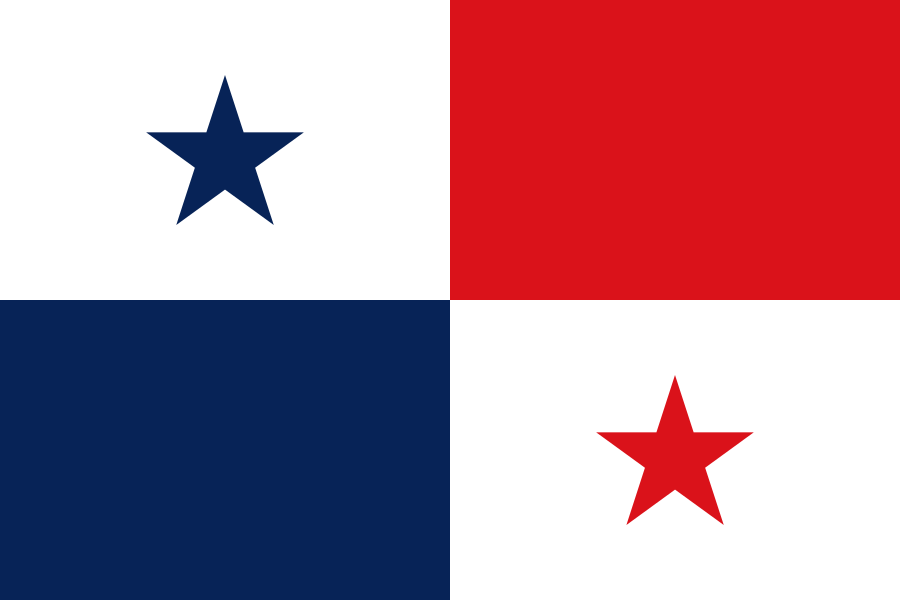
The market
Panama is one of the oldest online-licensing jurisdictions in the world: the JCJ began licensing online gaming under Resolución 65 of 25 October 2002, and issued its first online licence in 2003. It functions less as a domestic market and more as a regulated base from which operators serve international players, on the strength of the territorial tax system and a low headline rate. A 2020 reform allowed licensees to serve the local market too.
The domestic population is small, so the commercial logic is the licence and the tax treatment, not local player volume. Operators typically combine casino and sportsbook under one authorisation. The framework predates modern online gambling and has been adapted by regulation rather than rewritten.
Regulation and licensing
The regulator is the Junta de Control de Juegos (JCJ), under the Ministerio de Economía y Finanzas, established under Decreto Ley 2 of 1998, with online addressed in Resolución 65/2002. The licence is granted to a Panamanian-registered entity, which can be majority foreign-owned but must have local operational substance, for a term of up to seven years. Reported requirements include minimum capital and a guarantee deposit to the JCJ, plus fit-and-proper and AML checks.
On tax, licensed online operators pay 10% of GGR monthly. This is the figure I would rely on: multiple specialist legal sources tie the 10% GGR levy to Resolución 65/2002, and it is consistent with the JCJ’s own 2026 statements. A minority source cites 5.5% of GGR for online operators, but that appears to conflate the operator levy with the separate 5.5% tax on player winnings, which was a distinct tax and was eliminated in 2026. Under the territorial system, operators serving only foreign players are taxed only on Panama-sourced operations.
Marketing and player rules
The marketing regime tightened sharply in 2026. Bill 403, introduced in March 2026, brought in a near-total advertising ban and a new levy on operator profits to fund problem-gambling treatment through the Institute of Mental Health. On player taxation, the key 2026 change is the abolition of the 5.5% tax on winnings (which had also applied to the stake, introduced in 2015), scrapped to make Panama more competitive for tourism against Caribbean and US destinations. Player winnings are now tax-free.
What this means for your plan
Panama suits an operator that wants a low-tax, internationally recognised licence and a base to serve multiple markets, not one chasing a domestic player base. The 10% GGR rate and territorial treatment are the draw; the 2026 advertising ban under Bill 403 is the new constraint to price in. I would treat it as a hub licence rather than a market, and confirm the exact fee, guarantee and Bill 403 compliance cost against the JCJ directly before filing, because the advertising ban changes how you can acquire even international players.
Sources
- Pardini y Asociados, Internet Gaming in Panama, Resolución 65/2002, checked 5 September 2026
- LegalBison, Panama gaming licence 2026, 10% GGR under Resolución 65/2002, checked 5 September 2026
- Newsroom Panama, Panama to scrap the 5.5% tax on gambling winnings, checked 5 September 2026
- Gamblingmaps, Panama gambling laws 2026, Bill 403 advertising ban, checked 5 September 2026