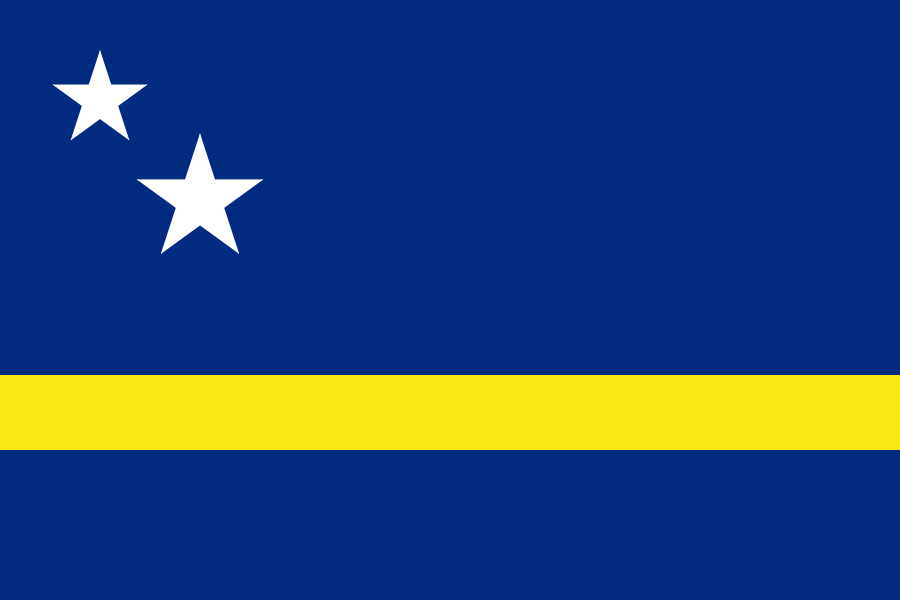
The market
Curacao is a licensing hub, not a player market. It is the historic workhorse offshore licence, used by operators serving grey and semi-regulated markets worldwide. The regime changed fundamentally with the LOK (Landsverordening op de Kansspelen), in force since 24 December 2024, which abolished the old master-licence and sub-licence system that defined the jurisdiction for three decades. Every operator now applies directly to the Curaçao Gaming Authority. The last master licence expired on 31 January 2025 and the orange transitional seal for operators still in application expired on 15 October 2025, so platforms without a current CGA licence lose their operating rights.
For an operator choosing a base, the appeal is cost and breadth: one B2C licence covers casino, sportsbook, live dealer and crypto verticals, and there is no tax on gaming revenue. The trade-offs are reputational and practical. Payment-service-provider and banking acceptance is weaker than tier-one European licences, and the LOK has added substance and supervision that the old regime lacked. The licence grants no access to regulated markets such as the EU, the UK or the US; each of those needs its own authorisation.
Regulation and licensing
Under the LOK the CGA issues two licence categories, B2C for operators and B2B for suppliers, plus a B2B certificate for certain non-critical service providers. The one-off application fee is EUR 4,592 for both B2C and B2B. The annual B2C fee is EUR 47,450, split into a EUR 24,490 licence fee to the National Treasury and a EUR 22,960 supervisory fee to the CGA. The annual B2B fee is EUR 24,490. There is no gaming-revenue tax. Fee figures are drawn from the CGA fee schedule version 2.0 dated 15 October 2025. The process runs through two phases with a provisional licence available, and typically takes three to six months.
Substance requirements have tightened: operators face continuous CGA supervision, AML and CFT audits, annual reporting, mandatory local server hosting, and a requirement to appoint a local key person in Curaçao by April 2027. A realistic all-in first-year budget once incorporation, a resident director and a compliance stack are added runs well above the government fees.
Marketing and player rules
As a licensing jurisdiction rather than a player market, Curacao’s own advertising and player-limit rules matter less than those of the markets an operator actually targets. The LOK does impose player-facing obligations on licensees, including AML controls, incident reporting through the CGA portal, player-complaint reporting, and display of the CGA digital seal on licensed domains. Operators must still meet the marketing, bonus and responsible-gambling rules of every jurisdiction they serve.
What this means for your plan
I would treat Curacao as a cost-driven base for grey-market operations, not a badge of quality. Post-LOK it is more credible than it was, but you are paying more, holding real substance, and still explaining the licence to banks and payment partners. If your target markets accept it and you need one licence across verticals, it works. If you need tier-one banking or a route into regulated Europe, it does not, and you should price the substance and compliance load honestly before committing.
Sources
- The Point Legal, Curaçao gaming licence cost 2026 (CGA fee schedule v2.0), checked 5 September 2026
- AGBrief, CGA updates fee policy under the LOK framework, checked 5 September 2026
- PFSER, Curacao gaming licence 2026, checked 5 September 2026