Skip to content
← All markets
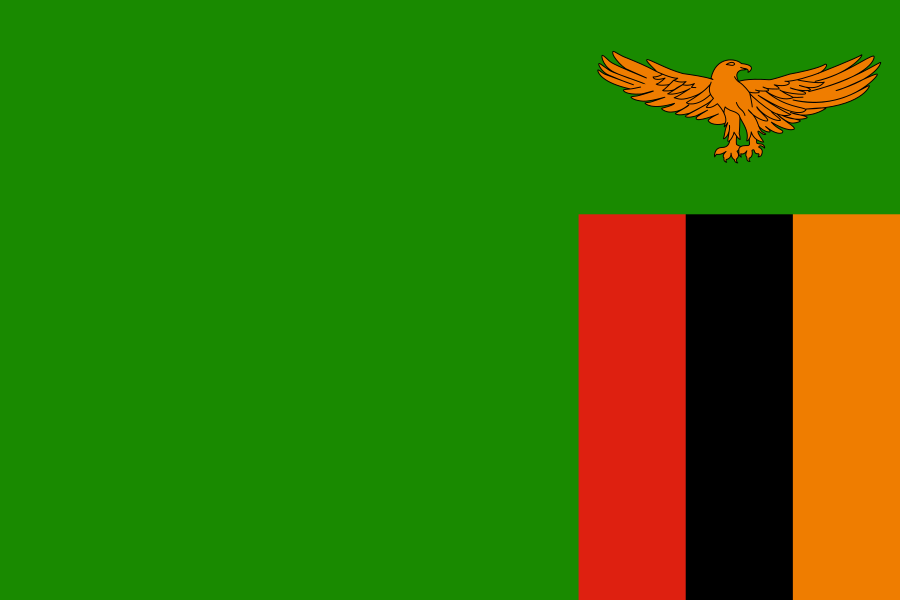
zm flag

Zambia

Regulated Gaming Board of Zambia
$130m
Total GGR 2025
Regulated + offshore
$150m
2026 projection
+15.0% YoY
62%
Channelization
Regulated share of total
80%
Mobile share
Of online GGR
+15%
CAGR 2021–2026
Compound annual

Zambia iGaming market in numbers

Metric 2025 2026
Total GGR $130m $150m
Regulated GGR $80m -
Offshore GGR $50m -
Channelization 62% -
Mobile share 80% -
YoY growth - +15.0%
CAGR 2021–2026 +15% -

Regulated and offshore split

Regulated GGR (2025) $80m
Offshore GGR (2025) $50m
Total 2025 $130m
2026 projection $150m
YoY growth +15.0%

Legal status by vertical

Online casino Partially legal
Sports betting Legal
Lottery Legal

Operator's read on Zambia

Zambia is a functional, betting-led African market whose central issue right now is tax volatility, and an operator should read it through that lens. The Betting Control and Licensing Board administers licensing across casinos, lotteries, sports betting and online under the Betting Control Act, and the regime works, but a new excise levy and an active government-operator dialogue mean the rates are genuinely in flux. The strategic point is that market access is workable, but an operator has to model multiple tax scenarios because the cost base is not yet settled.

The 2025 excise duty is the flashpoint. Zambia introduced a 10% excise duty on betting in 2025, and the leading operators Betway and betPawa challenged it in court, warning of shutdowns and job losses, but the Constitutional Court dismissed the bid to block it, upholding it as a legitimate consumption tax. A 15% withholding tax on winnings is maintained, and a 1% turnover-tax compliance framework now applies as well. For an operator, that layered tax structure is the defining cost question, and it has already survived a legal challenge.

The November 2025 dialogue means rates could still move. In November 2025 the finance minister announced the government would consult operators to resolve concerns over the new levy, signalling openness to recalibration without destabilising the sector, and the 2026 revised budget sharpened compliance oversight. So the tax position is genuinely live: it could ease through the dialogue or tighten through compliance enforcement. An operator entering now should model multiple tax outcomes rather than assuming the current structure is fixed.

The market is betting-led and wallet-driven. Play is dominated by sports betting and runs on mobile-money rails, so the product has to be mobile-money-native and built for betting rather than casino. Betway and betPawa lead the market, so a new entrant competes against established books with local distribution, which means differentiation matters. The fundamentals are sound, but the tax uncertainty overlays everything.

What winning looks like. Winning in Zambia looks like a mobile-money-native betting product, engagement with the operator dialogue to influence and anticipate the tax path, and financial modelling that accommodates multiple tax scenarios rather than betting on one. The operators who do well stay close to the regulatory conversation and build enough margin headroom to absorb a tax that has already proven willing to move.

The regional play. Zambia sits in the Southern and East African cluster near South Africa and Tanzania, mobile-money-led betting markets where shared infrastructure travels well. How Zambia fits a regional African sequence, given its tax volatility, is part of the multi-market sequencing piece, and the licensing position is on the Zambia licence page.

The biggest mistake. The biggest mistake is modelling Zambia on a single fixed tax when a new excise has just survived a court challenge and the government is actively consulting on the rate. The related mistake is using a non-mobile-money product in a wallet-driven betting market. Model multiple tax scenarios, engage the operator dialogue, and build mobile-money-native with margin headroom for a moving cost base.

What's changing

Government engaging operators Nov 2025 on regulatory dialogue.

Where these figures come from

  • Gambling Talk Nov 2025

GGR figures are 2025 estimates or actuals where regulator data is available; 2026 projections drawn from the most recent published forecasts. Offshore figures are inherently more uncertain than regulated figures and should be treated as directional. Where reputable sources disagree materially the dataset uses the midpoint of the range.

Zambia iGaming: operator questions

Is online betting licensable in Zambia?
Yes. The Betting Control and Licensing Board administers licensing across casinos, lotteries, sports betting and online under the Betting Control Act. The regime is functional and betting-led; the live issue is tax, which is currently in flux.
What is the betting tax in Zambia?
Zambia introduced a 10% excise duty on betting in 2025, which the Constitutional Court upheld after Betway and betPawa challenged it. A 15% withholding tax on winnings is maintained, and a 1% turnover-tax compliance framework now applies as well.
Could Zambia's gambling taxes change again?
Yes. In November 2025 the finance minister announced the government would consult operators over the new levy, signalling possible recalibration, while the 2026 revised budget sharpened compliance oversight. The tax position is genuinely live, so model multiple scenarios.
What matters most for entering Zambia?
A mobile-money-native betting product, engagement with the operator dialogue, and financial modelling that accommodates multiple tax outcomes rather than one fixed rate. Zambia pairs with South Africa and Tanzania. See the sequencing piece.
iGB London · 1-2 July 2026
Meet me at iGB London, 1-2 July 2026.
WhatsApp