Skip to content
← All markets
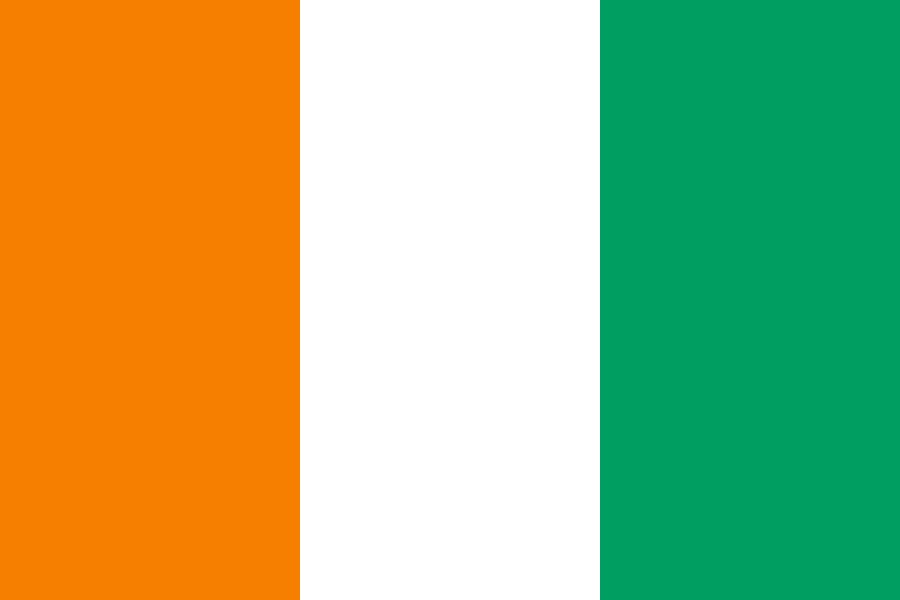
ci flag

Côte d'Ivoire

Regulated LONACI + Ministry of Finance
$220m
Total GGR 2025
Regulated + offshore
$250m
2026 projection
+14.0% YoY
59%
Channelization
Regulated share of total
85%
Mobile share
Of online GGR
+16%
CAGR 2021–2026
Compound annual

Côte d'Ivoire iGaming market in numbers

Metric 2025 2026
Total GGR $220m $250m
Regulated GGR $130m -
Offshore GGR $90m -
Channelization 59% -
Mobile share 85% -
YoY growth - +14.0%
CAGR 2021–2026 +16% -

Regulated and offshore split

Regulated GGR (2025) $130m
Offshore GGR (2025) $90m
Total 2025 $220m
2026 projection $250m
YoY growth +14.0%

Legal status by vertical

Online casino Prohibited
Sports betting Legal
Lottery Legal

Operator's read on Côte d'Ivoire

Côte d'Ivoire is the anchor of Francophone West Africa, and an operator should read it as a state-concession market rather than an open-licensing one. Under the 2020 gambling law, the state lottery LONACI holds the exclusive concession for lotteries, sports betting and online games, while a separate authority oversees casinos and slots. Sports betting is licensed, the market is French-language and mobile-money-led, and growth is strong, but legal access runs through LONACI rather than a standard licence application. The strategic point is that entering Côte d'Ivoire means negotiating with the state lottery, not applying to a regulator.

Market access is a concession, not a licence. Because LONACI holds the exclusive concession across sports betting and online games, a foreign operator's route to legal operation is a concession or approval arrangement with the state lottery. That makes the partnership negotiation the gating condition, much as it is in other Francophone and monopoly markets. An operator that treats Côte d'Ivoire as an open-licensing market will find there is no such regime to apply to; the state lottery is the gateway.

The tax tightened in 2025. Corporate income tax on gambling companies was raised to 30% in 2025, and a 15% withholding tax on winnings applies. That raises the cost of operating and affects player behaviour at the same time, so an operator modelling Côte d'Ivoire has to build the current tax position into the economics rather than relying on older, lighter assumptions. The tightening signals a state extracting more value from a growing market.

The market is mobile-money-led and French-language. Play runs on mobile money, with Orange Money and other wallets the core rails, and cash-via-agent and mobile payments dominating over cards. The product has to be built mobile-first and in French, fitted to how Ivorians actually transact. Operators porting a card-first or English-language product struggle, and the market churns: established international books compete here, and at least one major operator exited in late 2025, which signals both opportunity and difficulty.

What winning looks like. Winning in Côte d'Ivoire looks like a credible concession arrangement with LONACI, a mobile-money-native French-language product, and pricing built around the 30% corporate tax and 15% winnings withholding. The operators who do well treat the state-concession structure as the entry condition and build for the Francophone mobile-money player, rather than expecting an open market or a ported product to work.

The regional play. Côte d'Ivoire is the natural anchor for a Francophone West African strategy that can extend to Senegal, and it sits in the broader African growth cluster with Ghana next door in the Anglophone bloc. How it fits a regional African sequence is part of the multi-market sequencing piece, and the licensing detail is on the Côte d'Ivoire licence page.

The biggest mistake. The biggest mistake is treating Côte d'Ivoire as an open-licensing market when LONACI holds the exclusive concession and access runs through the state lottery. The related mistake is using a card-first or non-French product in a mobile-money, Francophone market. Negotiate the concession route, build mobile-money-native and in French, and price in the 2025 tax increases.

What's changing

Stable framework; Francophone West Africa anchor.

Where these figures come from

  • LONACI 2024
  • Statista

GGR figures are 2025 estimates or actuals where regulator data is available; 2026 projections drawn from the most recent published forecasts. Offshore figures are inherently more uncertain than regulated figures and should be treated as directional. Where reputable sources disagree materially the dataset uses the midpoint of the range.

Côte d'Ivoire iGaming: operator questions

How does an operator enter Côte d'Ivoire?
Through a concession arrangement with the state lottery LONACI, which holds the exclusive concession for sports betting, lotteries and online games under the 2020 gambling law. There is no open private licensing regime, so the partnership negotiation with the state lottery is the gating condition.
What is the gambling tax in Côte d'Ivoire?
Corporate income tax on gambling companies was raised to 30% in 2025, and a 15% withholding tax on winnings applies. An operator must build the current tax position into the economics rather than relying on older, lighter assumptions.
How do players pay in Côte d'Ivoire?
Through mobile money. Orange Money and other wallets are the core rails, with cash-via-agent and mobile payments dominating over cards. The product has to be mobile-first and in French, fitted to how Ivorians actually transact.
Why does Côte d'Ivoire matter strategically?
It is the anchor of Francophone West Africa, a French-language, mobile-money-led growth market that pairs with Senegal for a regional strategy. Entry runs through the LONACI concession, not an open licence. See the licence page and the sequencing piece.
iGB London · 1-2 July 2026
Meet me at iGB London, 1-2 July 2026.
WhatsApp