iGaming payment risk management is the process of identifying, controlling and monitoring the financial, operational, fraud and regulatory risks that arise when players deposit and withdraw money. It covers much more than card chargebacks. A casino can have excellent authorisation rates and still have a dangerous settlement concentration, an unworkable rolling reserve, weak source-of-funds controls or withdrawals that do not reconcile to its ledger.
For operators, the correct objective is safe, verifiable and resilient payment performance, not the highest possible deposit acceptance rate at any cost. Restricting every unusual player is not an acceptable shortcut either. Unnecessary friction can make a legitimate customer journey worse, while blunt controls may fail to detect the actual abuse.
This is an operator-side framework for online casinos and sportsbooks, with extra attention to Great Britain’s 2026 regulatory sources. Requirements differ by market, licence and payment arrangement. This article is not legal advice or an independent certification of any payment provider.
Payment risk management in one table
The first decision is to separate risks that are often grouped together as “payment fraud”.
| Risk category | Typical warning sign | Financial or regulatory exposure | Accountable owner |
|---|---|---|---|
| Chargebacks and disputes | Rising disputes, missing evidence, repeat disputed deposits | Lost transactions, fees and network scrutiny | Payments and finance |
| Account and identity fraud | Third-party cards, synthetic identities, multiple linked accounts | Fraud loss, account takeover, AML and customer harm | Fraud, AML and security |
| Prohibited or unsuitable payments | Restricted jurisdiction, product, card or wallet funding route | Regulatory breach and processing termination | Compliance and payments |
| PSP concentration | One provider, shared acquiring dependencies, repeated outages | Lost deposits, delayed payouts and business interruption | Payments lead and treasury |
| Settlement and reserve exposure | Unexpected withheld funds or unexplained net settlement | Liquidity pressure and unreconciled balances | Treasury and finance |
| Withdrawal integrity | Mismatched payee, unusual payout method, missing AML checks | Financial crime, loss and delayed legitimate withdrawals | Payments operations and AML |
| Data and reconciliation errors | Duplicate callbacks, orphaned transactions, stale ledger | Incorrect player balances and inaccurate accounts | Engineering and finance |
| Customer protection | Ineligible or excluded customers can deposit, or valid payouts are unreasonably delayed | Regulatory breaches, complaints and harm | Compliance, safer gambling and product |
Do not allow a provider’s aggregate “fraud protection” score to substitute for specific acceptance criteria. Request the actual control, its decision log, the alert owner and the escalation procedure.
1. Start with a risk register, not a provider ranking
A payment risk register should answer five questions for each material scenario: what could fail, how would we know, who can act, what happens to funds, and when is the control reviewed?
Separate inherent risk before safeguards from residual risk after controls. Score probability and impact using a documented internal scale; do not copy regulatory risk numbers and present them as your own business assessment. A probability score without incident evidence is still an estimate.
A useful minimum register contains:
| Field | Example: processor outage |
|---|---|
| Scenario | Primary PSP cannot accept deposits for a permitted market |
| Evidence | API errors, monitoring alerts, attempted deposit conversion |
| Exposure | Interrupted deposits, support load, outstanding payouts |
| Prevention | Contract review, tested approved backup route, settlement calendar |
| Detection | Alerts on error rates and reconciliation exceptions |
| Response owner | Payments lead with engineering and compliance |
| Response | Disable failed route, explain status, activate eligible fallback only |
| Recovery measure | Time to restore approved deposit journey and reconcile pending attempts |
| Review | After each incident and during regular risk review |
An apparently redundant second PSP may still share the same bank, card scheme dependency or orchestration control plane. Verify independence instead of counting logos.
For a deeper explanation of cashiers, PSPs and acquiring, use the casino payment processing guide. That companion article covers how payments work and what they cost; this one focuses on where the system can fail and how to control it.
If you are weighing bank-to-bank payments, e-wallets or local rails, the iGaming alternative payment methods guide applies the same funding and withdrawal controls to each option.
2. Chargeback risk and card-network monitoring
A chargeback can arise from unauthorised payment activity, a service or transaction dispute, operational errors or customer misunderstanding. It should not automatically be treated as evidence of deliberate customer fraud.
The operator needs a process that starts before the dispute notice:
- Capture the original transaction ID, consent and payment-method eligibility.
- Keep the authentication and processing evidence available within the applicable data-retention rules.
- Record wallet-credit and any game-play activity under the same durable player and transaction identifiers.
- Make statements and descriptors understandable so legitimate customers recognise their payment.
- Triage early disputes, pre-dispute notices and formal scheme cases according to contractual and scheme deadlines.
- Respond with relevant, lawful evidence, protect sensitive data and track outcomes by reason code.
- Investigate repeat disputes, sudden source changes and potential account takeover without automatically blocking legitimate complaints.
Do not invent one universal safe chargeback rate. Card networks and acquirers define monitoring populations, thresholds, timing and consequences differently. Visa’s VAMP programme combines fraud and dispute monitoring for relevant card-not-present transactions. Operators must obtain their current regional programme rules and merchant thresholds from their acquirer instead of copying a percentage from a dated blog.
A sensible reporting pack separates dispute counts, disputed transaction value, confirmed fraud signals, chargeback-related fees and actual unrecovered principal. Combining them creates misleading loss calculations. Record the cohort and timing differences, because a chargeback arriving this month may relate to a transaction in an earlier month.
Dispute operations: what I would measure
| Measure | Suggested working definition | Why it matters |
|---|---|---|
| Dispute incidence | Disputes received / applicable settled transactions, in a consistent observation window | Identifies pressure; do not confuse with scheme-specific monitoring ratios |
| Disputed value | Total value of transactions under dispute | Measures exposure, not automatically booked loss |
| Win / recovery rate | Successfully recovered disputed value / eligible disputed value | Tests evidence quality and operational response |
| Fraud loss | Confirmed unrecovered principal and related direct losses | Separates actual loss from open investigation |
| Evidence timeliness | Cases answered within contractual deadline / cases requiring response | Shows dispute process reliability |
| Root-cause mix | Cases by reason, market, issuer, device and payment method | Helps distinguish product friction from criminal behaviour |
If your payment partner cannot provide scheme-level dispute reports or raw events, document that reporting gap before renewing the contract.
3. Account takeover, third-party funding and payment abuse
A casino’s payment risk assessment must examine the customer identity, not just the card result. Account takeover, mule accounts, stolen instruments, device sharing and third-party funding can each present different risks and require different responses.
Useful signals may include a sudden change in device or geography, repeated use of unrelated payment instruments, multiple accounts funding from the same source, irregular withdrawal destinations or mismatches between verified identity and account-holder information. None of these indicators is proof on its own. They should trigger a proportionate review according to documented policy.
In its 30 July 2026 sector assessment, the UK Gambling Commission maintained a high money-laundering risk rating for remote casinos and highlighted risks involving identity-document fraud, AI-enabled impersonation, mule accounts and certain payment arrangements. That is a regulator assessment of a sector, not a finding against a particular operator.
Design review queues that distinguish:
- Fraud prevention: potential unauthorised payment or account compromise.
- AML / financial crime: unusual source, destination or movement of funds.
- Safer gambling: potential customer vulnerability, exclusion or harmful behaviour.
- Commercial disputes: legitimately contested transactions and support failures.
These teams may use overlapping evidence, but they have different duties, thresholds, permitted decisions and escalation routes. A customer who contacts support about an incorrect debit should not be treated as a suspected fraudster by default.
Risk-based checks should be proportionate
A low-risk legitimate depositor should not automatically be subjected to the same manual procedure as an account showing several material warning signs. At the same time, marketing conversion metrics do not justify disabling mandatory identity, sanctions or safer-gambling controls.
For Great Britain, LCCP 17.1.1 requires customer identity verification before gambling. It also restricts operators from demanding at withdrawal information they could reasonably have requested earlier, while recognising additional legal obligations that can arise at that point. Build verification earlier in the journey where the requirement already exists.
4. Open-loop payouts, source of funds and withdrawal risk
A closed-loop withdrawal typically returns money to the same payment method or account used for deposits, where appropriate and supported. An open-loop payout sends it through a different route. Open-loop transactions can be legitimate in constrained circumstances, but the risk is that an operator becomes a mechanism for moving value between otherwise unrelated accounts.
The UK Gambling Commission’s April 2025 emerging-risk guidance strongly recommends closed-loop payments and expects effective risk assessment and controls where open-loop arrangements remain. This is not a statement that every exception is automatically prohibited.
A practical payout approval workflow distinguishes:
- Verified customer and permitted jurisdiction.
- Available withdrawable balance and any applicable legal restriction.
- Known payment owner and eligible payout destination.
- Fraud / AML and safer-gambling review where required.
- Payout instruction issued once, with an immutable payment ID.
- Provider confirmation, reversal and settlement status.
- Player communication and reconciliation of the final state.
Do not use withdrawal friction as a retention tool. The objective is lawful, prompt payment and accurate controls, not making it harder for a legitimate customer to leave. An operator should be able to explain any justified restriction and document why it was applied.
5. Jurisdictional payment controls: the UK example
A gambling licence, PSP approval and supported gateway integration are three different things. All three must match the actual player jurisdiction, operator entity, gaming product and payment instrument.
For British-facing operations, confirm the current rule texts in the UK Gambling Commission LCCP:
| UK requirement | Verified source | Operator implementation question |
|---|---|---|
| AML risk assessment and effective controls | LCCP 12.1.1 | Is the payment risk assessment reviewed after relevant changes and at least annually? |
| Eligible payment providers | LCCP 5.1.2 | Is the provider a qualifying payment service provider for the relevant service? |
| No credit-card-funded gambling | LCCP 6.1.2 | Are prohibited direct and indirect, including relevant e-wallet, credit-card funding paths blocked? |
| Customer identity | LCCP 17.1.1 | Can we prove identity verification happened at the required stage? |
| Changes to payment methods / processors | UKGC emerging risks, October 2025 | Has the necessary key-event reporting and payment-risk review been completed? |
The credit-card ban also covers payments funded through a money service business in relevant circumstances. Check the Commission’s wallet-funding explanation. Do not assume a wallet’s own branding hides the ultimate funding method.
These are Great Britain-specific examples, not rules automatically applicable to Curaçao, Anjouan, Nevis, Malta or other markets. A foreign casino licence is not permission to process transactions from any country. Define a country-level control matrix and obtain local advice where needed.
6. PSP failure, rolling reserves and restricted liquidity
The most damaging payment incident is not always a deposit decline. It can be discovering that the money accepted last week is not available to fund legitimate withdrawals this week.
A PSP may have contractually agreed reserves, delayed settlements, rights of set-off or termination provisions. A merchant’s business model should explicitly reflect those terms, especially where payouts are faster than deposits settle.
The treasury register should include:
- Each contracting entity and merchant account.
- Settling bank and payment provider, with critical dependencies.
- Expected deposit settlement timetable by method.
- Funds held in fixed or rolling reserves, with their release dates.
- Outstanding approved withdrawals and provider payout balances.
- Charges, refunds and disputes awaiting reconciliation.
- Contract termination, wind-down and data-export clauses.
- Concentration across banks, acquirers, providers and currencies.
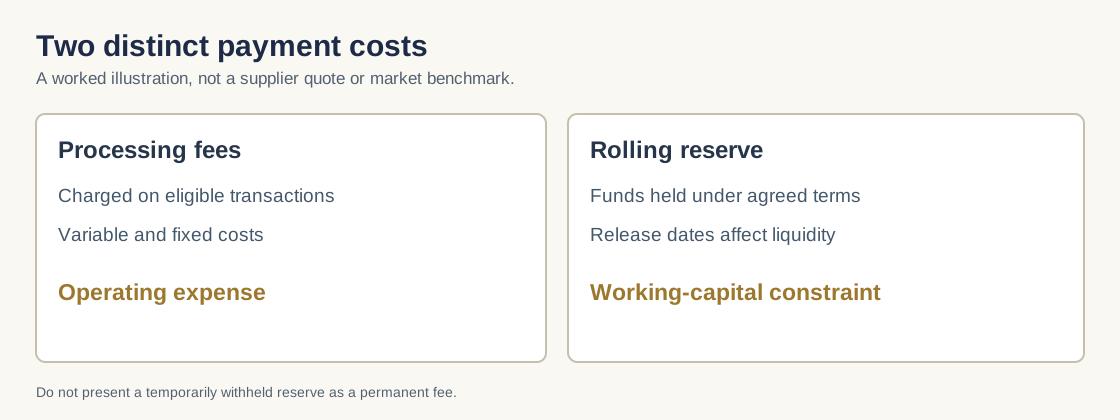
Worked example: direct losses versus cash unavailable
This example is illustrative arithmetic, not typical industry pricing. Suppose an operator has 800 settled deposits averaging €50 each. Settled deposit value is €40,000.
Assume €1,230 of processing charges, eight €50 disputes that ultimately result in loss of principal, €15 per dispute in additional fees, and a hypothetical 10% rolling reserve on the original €40,000.
| Treatment | Illustrative amount |
|---|---|
| Total settled deposit value | €40,000 |
| Processing expenses | €1,230 |
| Lost principal on eight disputes | €400 |
| Additional dispute fees | €120 |
| Direct cost / loss in this simplified example | €1,750 |
| Reserve temporarily withheld | €4,000 |
| Illustrative remaining immediately available cash | €34,250 |
Here, €4,000 is not automatically an expense. It is temporarily inaccessible cash subject to the contract’s release and dispute arrangements. The €34,250 represents simplified cash availability after the listed items, not NGR or profit. Actual merchant settlement arithmetic may allocate reserves, chargebacks and fees to different periods or balances. Finance should reconcile their real contract rather than copy this model.
If a PSP freezes settlement or stops accepting gaming transactions, operators need a legally approved response plan. That means understanding provider obligations, payout continuity, player messaging, cash coverage, reserve release and data portability before the incident.
7. Ledger integrity, data security and reconciliation
A payment operation is not controlled if its finance team cannot join a player’s confirmed wallet movement to a processor record and a real bank settlement.
The minimum data trail uses stable IDs for: player, external payment, internal wallet event, reversal or refund, provider settlement line, reserve movement and dispute case. The operator must protect personal and payment data appropriately; analysts usually need minimised or pseudonymised records, not raw full card details.
Test five situations in a non-production environment:
- Duplicate callback: The PSP delivers a successful deposit event twice. The player’s wallet must be credited exactly once.
- Delayed callback: A completed deposit response arrives after the cashier times out. The reconciliation process must recover the state without inventing an extra payment.
- Withdrawal reversal: Provider says a payout was rejected after the PAM marked it pending. The ledger records the reversal and notifies operations appropriately.
- Reserve deduction: Provider settles less than expected due to a documented reserve; finance can distinguish reserved cash from unexplained shortfall.
- Provider outage: New transactions stop or fail cleanly, existing authorisations remain traceable, and an eligible route can be restored with appropriate governance.
For cardholder data, assess the operator’s actual scope under PCI DSS with the acquiring and technology partners. A hosted cashier or tokenisation can reduce exposure, but it does not erase all contractual, legal or data-security responsibilities.
8. The dashboard that payment, finance and compliance should share
A single “approval rate” chart is not a risk dashboard. I would expect a weekly view containing:
| KPI | Operational definition | Owner |
|---|---|---|
| Deposit submission and completion | Eligible cashier journeys reaching attempt; confirmed credited deposits | Payments and product |
| PSP authorisation and technical failure | Eligible attempts approved, declined, timed out or retried, separately | Payments and engineering |
| Dispute incidence and value | Cases within a consistent denominator and dispute ageing | Fraud and finance |
| Unreconciled items | Open mismatches by count, amount and age | Finance |
| Provider exposure | Share of deposits and payouts through each real underlying dependency | Treasury |
| Reserve coverage | Held funds, expected release date and funding obligations | Treasury |
| Payout exceptions | Valid requested payouts by reason and ageing | Payments and compliance |
| AML / identity escalations | Open reviews, overdue actions and authorised decisions | AML and fraud |
| Customer-impact incidents | Legitimate blocked payments, support contact and unresolved payout complaints | Product and support |
Segmentation is essential. A blended approval rate can improve simply because the share of countries, methods or transaction sizes changed. Compare consistent cohorts, document which cases were excluded, and investigate the full deposit-to-withdrawal funnel.
Do not give employees a dashboard with sensitive customer information they do not need. Access rights, retention limits, redaction and audit logs are part of payment-risk control.
9. A 30-day payment risk audit
For an operator with an existing cashier, I would use a four-week review rather than select a new PSP on a product demonstration alone.
Week 1: establish the baseline. Map legal entities, permitted player markets, cashier methods, data events, KYC and self-exclusion gates. Document the live and expected payment routes and identify inconsistent KPI definitions. Deliver a transaction-event dictionary and owner matrix.
Week 2: quantify exposure. Reconcile settlement reports, processor fees, disputed payments, reserve schedules, pending withdrawals and funding requirements. Distinguish paid fees from money withheld and potential liabilities. Deliver a risk register and treasury bridge.
Week 3: run controlled exception tests. Simulate duplicate events, stale customer eligibility, unavailable PSP, third-party funding concerns, changed payout destination and chargeback notifications. Do not use real customer funds for unsafe tests. Deliver evidence of control pass/fail and escalation owners.
Week 4: approve the response plan. Prioritise fixes, assign timelines and budgets, agree reporting to senior management, update relevant risk assessments, and schedule re-testing. Deliver a 90-day action plan rather than a list of software suppliers.
The success measure is not an imaginary uplift percentage. It is demonstrable reduction in known exposures, clearer cash availability, fewer unresolved reconciliation cases and a properly controlled payment journey.
Questions for a PSP, PAM and payment orchestration provider
Before a contract or renewal, ask:
- Which exact entity, gambling products and customer countries are approved in writing?
- Who is the acquirer, bank, settlement recipient and owner of merchant identifiers?
- Which chargeback and card-network monitoring reports can the operator export?
- What are the withheld-funds, reserve-release and termination provisions?
- Can the operator obtain raw transaction and settlement identifiers?
- What is the API behaviour for duplicate callbacks, refunds and partially completed payouts?
- Who manages KYC / AML / safer-gambling eligibility, and at which stage is the rule applied?
- What happens to pending player withdrawals if a provider contract ends or service is suspended?
- Which support and fraud-response teams can be contacted during an incident?
- Which contractual reports, payment credentials and data can be moved to an alternative authorised provider?
If the vendor cannot give concrete answers, another feature slide is unlikely to help.
FAQs about iGaming payment risk
What is payment risk management in iGaming?
It is the systematic oversight of deposit and withdrawal fraud, chargebacks, legal payment restrictions, AML controls, provider concentration, settlement, reserves, reconciliation, data integrity and customer impact.
How can an online casino reduce chargebacks?
First classify disputes accurately, maintain compliant transaction and authentication evidence, fix legitimate cashier and customer-service problems, and investigate the specific fraud patterns causing losses. Follow the acquirer’s current card-network obligations rather than trying to target a made-up universal ratio.
Are rolling reserves a payment processing fee?
Usually not in the same accounting sense. An agreed reserve withholds access to cash and can create significant liquidity risk. Separate direct expenses, outstanding disputes, the amount held, and contractual release terms.
Can a casino use a backup PSP if the primary provider blocks transactions?
Only when the secondary relationship actually supports the same legal entity, gambling activity and market. A backup must never be used to disguise prohibited transactions, sidestep acquiring restrictions or bypass AML and other legal obligations.
Can withdrawals go to a different payment method?
Some arrangements permit controlled exceptions, but open-loop flows carry financial-crime risk and may be restricted. The operator must follow market rules, verify beneficiary ownership and document the reason and approval for deviations.
Does the payment processor handle all KYC and AML obligations?
No. Third-party services can support checks, but the licensed operator retains its own obligations. The UKGC expressly reminds licensees not to rely on a payment processor’s KYC as a substitute for the operator’s due diligence.
How often should a payment risk assessment be reviewed?
That depends on the market and risk profile. Under Britain’s LCCP 12.1.1, AML risk assessments must be updated when circumstances change and reviewed at least annually. Operational incident and treasury monitoring should be more frequent.
What is the first thing a new operator should check?
Start with legal eligibility of the player, merchant and method, then verify the contract’s settlement, reserve and payout terms. An attractive approval rate cannot solve an unlawful route or an inability to fund valid withdrawals.
Get a second opinion before payment risk becomes an incident
A provider comparison tells you what software can do. A payment risk audit tells you where your operator is exposed, which controls are missing and how your commercial and compliance teams should respond.
I can help structure an independent review of the cashier journey, PSP dependencies, transaction reporting, reserves and payment operations, with a written priority list for the relevant internal owners. I am not presenting this as legal certification or guaranteeing a particular processor approval.
Discuss your payment risk exposure →
For payment architecture and cost modelling, continue with the casino payment processing guide. Operators still planning a launch can also review white-label casino costs.
Research and source notes (reviewed 24 October 2026): UKGC 2026 remote casino risk assessment; LCCP 12.1.1; LCCP 17.1.1; LCCP 5.1.2; LCCP 6.1.2; UKGC emerging risks April 2025; UKGC emerging risks October 2025; Visa VAMP overview; PCI DSS.
About the author: Henk Wolff, independent iGaming strategy consultant. This is an operator-side decision framework informed by public primary regulatory sources and payment-operations research, not a representation of private client records, audited vendor metrics or legal approval. No payment provider paid for placement.