
Alternative payment methods (APMs) for iGaming are ways to fund and withdraw from a licensed gambling account beyond a conventional direct card payment. They include bank-to-bank payments, open banking, e-wallets, certain local banking rails, vouchers and, where lawful, cryptoasset arrangements.
The useful question is not “Which casino payment method is best?” It is which combination is permitted for our exact operator, market and gaming product, usable by our players, operationally reliable and safe for withdrawals? A method being available to ordinary online retailers does not make it available to casinos.
The strongest setup is rarely the longest list of payment logos. Operators should select a small, evidence-backed mix, verify actual merchant approval and measure deposit completion, cash access, reconciliation and legitimate withdrawal experience. This article is a practical selection and implementation guide, not a list of allegedly universal provider prices.
Important 2026 update: Brazil’s Ministry of Finance states that Provisional Measure 1.394 of 25 September 2026 prohibited fixed-odds betting and online games nationwide, including offers directed at people in Brazil from abroad. The Ministry’s published transition stopped new platform funding on 25 September. Some older casino payment guides still recommend Pix as an actively available gambling deposit option. Do not read general Pix availability as current permission to serve Brazilian gamblers. Check any subsequent legal developments with Brazilian counsel and the Ministry before market entry.
Quick comparison: which alternative payment method fits?
| Method family | What the player actually uses | Operator advantage | Main limitation to verify | Withdrawal question |
|---|---|---|---|---|
| Open banking / pay by bank | Authorised payment initiated from a bank account | Potentially smooth bank authentication, clear account references | Bank and PISP coverage, gambling merchant approval, payment status | Is an authorised return payout supported to the verified owner? |
| Instant or local bank rails | A country-specific transfer or instant-payment scheme | Familiar local user experience where supported | Market and operator eligibility, local cut-offs, irreversibility rules | Can the receiving account be verified and paid out promptly? |
| E-wallets | Wallet balance or supported funding instrument | Familiar checkout for existing wallet users | Underlying source of funds, country permissions and gambling restrictions | Does the wallet permit lawful withdrawals and settlement? |
| Prepaid vouchers | Prepaid balance or redeemable code | Alternative to traditional bank checkout for eligible customers | AML traceability, funding origin, refund and payout limitations | Where can winnings lawfully and transparently be returned? |
| Cryptoasset route | Custodial or non-custodial wallet through an approved partner | An option for crypto-native audiences in permitted markets | Licencing, custody, sanctions, chain analysis, banking off-ramp, volatility | Can the operator make lawful customer payouts and settle in fiat? |
| Tokenised card wallet | Apple Pay / Google Pay and underlying card or account | Potentially simpler card authentication | Often still a card transaction, with card and gambling restrictions | Is withdrawal back to the original eligible method possible? |
This is a capability and risk matrix, not a product endorsement. Method costs, chargeback exposure, settlement timing and availability depend on provider contracts, customer geography, funding source and business classification. Never infer that a household name accepts your gaming merchant account.
The mistake: confusing a payment method with a processor
Payment architecture contains different layers:
- Payment method: the funding experience shown to a player, such as bank transfer, wallet or local payment scheme.
- Payment service provider (PSP): a company providing defined payment services under its applicable authorisation.
- Gateway or orchestration platform: software that connects and routes requests; a software integration alone does not create an approved merchant or banking relationship.
- Acquiring and settlement: the regulated institution or contractual arrangement moving or holding merchant funds.
- Casino player ledger: the operator’s source of truth for deposits, account balances, refunds and withdrawals.
One platform can perform several roles; those responsibilities still need separate contractual review. A cashier displaying “Pay by Bank” is not proof that the bank transfer is instant, the casino is approved to accept it, the transaction is irrevocable or payouts work in the other direction.
Use the companion casino payment processing guide for the full architecture, acquiring and reconciliation model. This guide concentrates on payment-method selection and market-specific rollout.
1. Open banking and account-to-account payments
Open banking commonly allows a player to authorise a bank payment through a regulated payment initiation service provider. A2A, or account-to-account, is a broader description of money moving between bank accounts. Not every A2A service uses the same underlying open-banking mechanism.
For a gambling operator the potential value is a payment that is familiar to bank-account users, with consent and confirmation handled in a bank-controlled journey. That can reduce some card-specific friction. But bank authentication is not a substitute for the casino’s own identity, AML or safer-gambling duties.
Companies in the broader pay-by-bank ecosystem include Trustly, TrueLayer, Brite, Zimpler and Volt. Their geographic availability, contracting entity, permitted gambling products and payout capabilities must be checked directly. A provider’s general geographic marketing footprint is not evidence of support for a particular casino and licence.
Why transaction status is harder than the sales brochure
Do not credit a real-money player wallet merely because the user completed a bank redirect. The integration must distinguish a payment that was initiated, authorised, accepted, settled, failed or refunded, according to the actual rail.
Under PSD2, the European Banking Authority addresses information-sharing after payment initiation. A payment initiation service and the bank’s execution status are not necessarily the same event.
Before launching, test delayed callbacks, duplicate events, technical timeouts, bank rejection, payer mismatch and reconciliation to bank settlement. Ensure each deposit is credited once and that pending transactions remain recoverable.
The European Commission’s instant euro payments update explains the euro-area obligations for instant transfers and payee verification introduced in 2025. An instant euro-transfer capability does not imply that a casino is legally eligible to use it, nor that your named PISP can settle the payment and pay out players for your merchant account.
2. E-wallets: brand recognition is not enough
Examples of consumer wallet brands and gambling-sector products include Skrill, Neteller, PayPal, ecoPayz, MiFinity and AstroPay. Naming them here is not a claim that each supports every gambling jurisdiction, deposit source or online casino product.
The operator needs two confirmations, in writing:
- Merchant eligibility: the named legal entity, licence, specific gambling product and customer countries are approved.
- Funding and withdrawals: the wallet can reject prohibited underlying funding sources, identify the payer appropriately and pay money out through a suitable route.
This distinction is particularly important in Great Britain. UK Gambling Commission LCCP 6.1.2 prohibits gambling payments by credit card, including through a money service business. The Commission’s specific e-wallet guidance says operators must reject wallets that have not blocked credit-card-funded gambling through their facilities. Putting a credit card behind a wallet is not a way around the rule.
Assess support experience too. If a customer can deposit but cannot receive a legitimate withdrawal to the same instrument, the operator must solve the payout route before offering the method. The cheapest deposit method is not necessarily the most sustainable payment option.
3. Local bank rails: method familiarity versus legal eligibility
Consumer payment habits differ dramatically by country. Local rails and branded consumer schemes can be relevant to operators, but only where the regulated gambling product and payment arrangement are independently permitted.
| Region / example rail | What to evaluate | Current gambling-specific caution |
|---|---|---|
| European Economic Area: SEPA and national bank schemes | Bank coverage, checkout redirect, local currency, instant-transfer compatibility | National gambling regimes and merchant acceptance differ; SEPA support is not gambling authorisation |
| Netherlands: iDEAL ecosystem | Local familiarity, identity matching and acquiring / PSP approval | Country-specific gaming rules and approved operators remain decisive |
| Poland: BLIK | Customer device flow and issuing-bank support | Do not imply BLIK accepts your casino merchant simply because it is widely used by consumers |
| Canada: Interac ecosystem | Eligible bank-account rails and permitted licensed gaming product | Provincial permissions and merchant acceptance must be checked |
| Mexico: SPEI | Local bank-to-bank experience, correct payee and currency controls | Payment-network access does not confer an online gambling right |
| Colombia: PSE | Customer bank journey, deposit reference and local settlement | Verify operator and merchant licences and permitted product |
| Brazil: Pix | Consumer rail as an infrastructure case study | Not a live iGaming deposit recommendation as of 24 October 2026 under the Finance Ministry’s published prohibition |
| Australia: PayID / bank transfer | Consumer bank-transfer infrastructure generally | ACMA says online casino services offered to people in Australia are prohibited; do not treat a bank rail as permission to target them |
These names are examples of consumer payment rails, not verified casino integrations. Country availability claims from aggregators should be challenged at the level of the precise contracting entity and actual merchant category.
What changed in Brazil in September 2026?
Until September, operator-facing articles often described Brazil’s regulated fixed-odds betting sector and Pix transfers. The Brazilian Ministry of Finance’s October 2026 explanation describes a nationwide prohibition introduced by Provisional Measure 1.394/2026. The stated transition ended voluntary balance withdrawals on 5 October and set further steps for returning remaining balances.
The general Pix network still exists as consumer financial infrastructure, but that does not make fixed-odds casino deposits permissible. Operator instructions and promotional materials must be updated accordingly. This page reflects the Ministry information available on 24 October 2026, not a prediction about future legislation.
Australia: online betting is not the same product as online casino
Australia’s ACMA differentiates regulated, licensed wagering from online casinos, which are prohibited from being offered to people in Australia. Even a payment provider that serves an Australian wagering business does not thereby approve an offshore real-money casino. Localisation should never override product legality.
4. Vouchers, prepaid cards and other cash-adjacent products
Prepaid cards and vouchers may allow customers to use a familiar funding route without presenting a traditional bank debit in the same session. Examples include paysafecard and Neosurf, subject to current product and market approval.
For an operator, the questions are not just the fee and deposit UX. Ask how the instrument was funded, what identity evidence is available, whether the purchase can be traced, whether a prohibited card or cash flow could finance gambling indirectly and where withdrawals go.
The UK Gambling Commission’s October 2025 emerging-risk guidance identifies prepaid methods as high risk and expects operators to incorporate them into AML assessments. It also emphasises restrictions on credit-card funding and required reporting when payment methods or processors change.
Prepaid is not an anonymous-by-design shortcut, and it is not automatically a sensible option for a new casino. If the payment method cannot support compliant customer due diligence and withdrawals, exclude it.
5. Crypto and stablecoin payment arrangements
Cryptoassets can be a viable separate payment category for particular lawfully operated gaming models and crypto-native customers. They introduce risks that cards and bank transfers do not: chain and token selection, sanctions exposure, wallet screening, custody, wrong-network deposits, exchange and de-pegging risk, fiat off-ramp, tax and accounting treatment.
Do not assume “crypto accepted” means an operator can offer the method everywhere. The licence, customer jurisdiction, custodian or gateway arrangements and bank counterparties must all permit the transaction.
A technical crypto transfer being difficult to reverse does not mean the operator has no consumer-protection duties or AML exposure. Fees may look smaller at the payment-leg level while the real cost emerges in custody, exchange spread, screening and treasury management.
Before a production launch, verify the legal structure, AML screening and sanctions decisions, custody ownership, customer identity checks, reconciliation, error recovery, wallet address policy, refunds and same-customer payouts.
The payment risk management article gives an operator checklist for funding integrity, treasury and dispute handling. Crypto-specific content should not be added to a casino cashier merely to avoid a bank or acquirer’s restrictions.
6. Why “Apple Pay” is not necessarily a new payment rail
Digital wallets such as Apple Pay and Google Pay may provide tokenised credentials for an underlying card or eligible account. In many integrations this is still a card transaction with the associated acquiring rules, consumer protections and gambling restrictions.
If a provider presents Apple Pay as an alternative payment method, ask:
- Which underlying instrument type does the casino receive: debit card, credit card, bank transfer or something else?
- Can prohibited funding sources be prevented for the precise gambling product and country?
- Is it a genuine new acquiring route or the existing card acquirer with a different checkout button?
- Do refunds and withdrawal obligations differ from a normal card deposit?
This is why I separate the customer-facing button from the settlement rail and merchant agreement.
7. Decide the payment mix by market, cohort and permitted product
An operator with three brands and several markets should not copy one cashier configuration across all brands. Start with a market-by-market eligibility register.
| Required field | Example decision to record |
|---|---|
| Licensed entity and product | Which company and approved online gambling product is taking the payment? |
| Player location and jurisdiction | Which markets may be served, and with which restrictions? |
| Customer eligibility | What identity, self-exclusion and AML checks must already be complete? |
| Proposed method / brand | Which bank transfer, wallet, prepaid method or tokenised card? |
| PSP, acquirer and settlement bank | Who is the real counterparty for the authorised transaction? |
| Underlying funding source | Can prohibited credit, third-party or anonymous funding reach the account? |
| Deposit lifecycle | Which statuses cause wallet credit, rejection or reversal? |
| Payout capabilities | How are legitimate winnings and balances returned? |
| Settlement and reserves | What funds are available, withheld or still in transit? |
| Operational owner | Who investigates exceptions and who approves launch? |
| Documented evidence | Merchant approval, contracts, regulator check, integration test and signed go-live review |
Only after this register is signed off should a growth or CRO team optimise payment-button ordering, field count or behavioural segmentation.
A realistic selection sequence
First: list markets and permitted gaming products. Remove prohibited combinations before contacting providers.
Second: examine existing customer payment preferences among legally eligible users. Break down genuine transaction results by method, country, device, funding source and new versus returning players.
Third: contact candidate PSPs and wallet firms. Request named legal-entity acceptance, regulated permissions, settlement terms, supported inbound and outbound routes, dispute handling and reference customers where disclosure is permitted.
Fourth: implement at most a few methods in a controlled pilot with reliable measurement. It is often better to prove one new bank route and one wallet route than add ten checkout buttons with untested back offices.
Fifth: test declines, mismatches, duplicate callbacks, reversals, downtime and legitimate withdrawal requests before full rollout.

8. Calculate real APM costs, not headline transaction fees
Headline processing fees rarely show the full economics. A useful provider comparison includes:
- Fixed setup and monthly commitments.
- Transaction fees, separately for deposits and payouts.
- Foreign exchange spreads and currency conversion.
- Settlement delay, withheld balances and rolling reserves.
- Dispute, refund, reversal and investigation fees where applicable.
- Integration, fraud review, account management and support cost.
- Failed or duplicated payment handling.
- Liquidity required to fund legitimate withdrawals before settlement.
A simple illustrative comparison
Suppose the operator has €50,000 of accepted deposit volume during a hypothetical period. One purely illustrative pricing model charges 2.5% on all deposits; another model routes 60% of value at 2.5% and 40% at 1%.
| Hypothetical calculation | Direct deposit fees |
|---|---|
| €50,000 at 2.5% | €1,250 |
| €30,000 at 2.5%, plus €20,000 at 1% | €950 |
| Illustrative difference | €300 |
Those numbers are not vendor quotes, industry averages, or a forecast of savings. They assume identical accepted volume, eligibility, payment mix and no extra costs. They ignore fixed fees, refunds, non-completion, FX, reserve treatment and withdrawals. A cheaper transaction fee can be a bad commercial decision if the product breaks payout integrity or reduces successfully funded deposits.
One meaningful KPI is total attributable payment cost per successfully credited euro, segmented by market and eligible player cohort. The denominator matters. Low fees on a method with many unsuccessful journeys can be expensive overall.
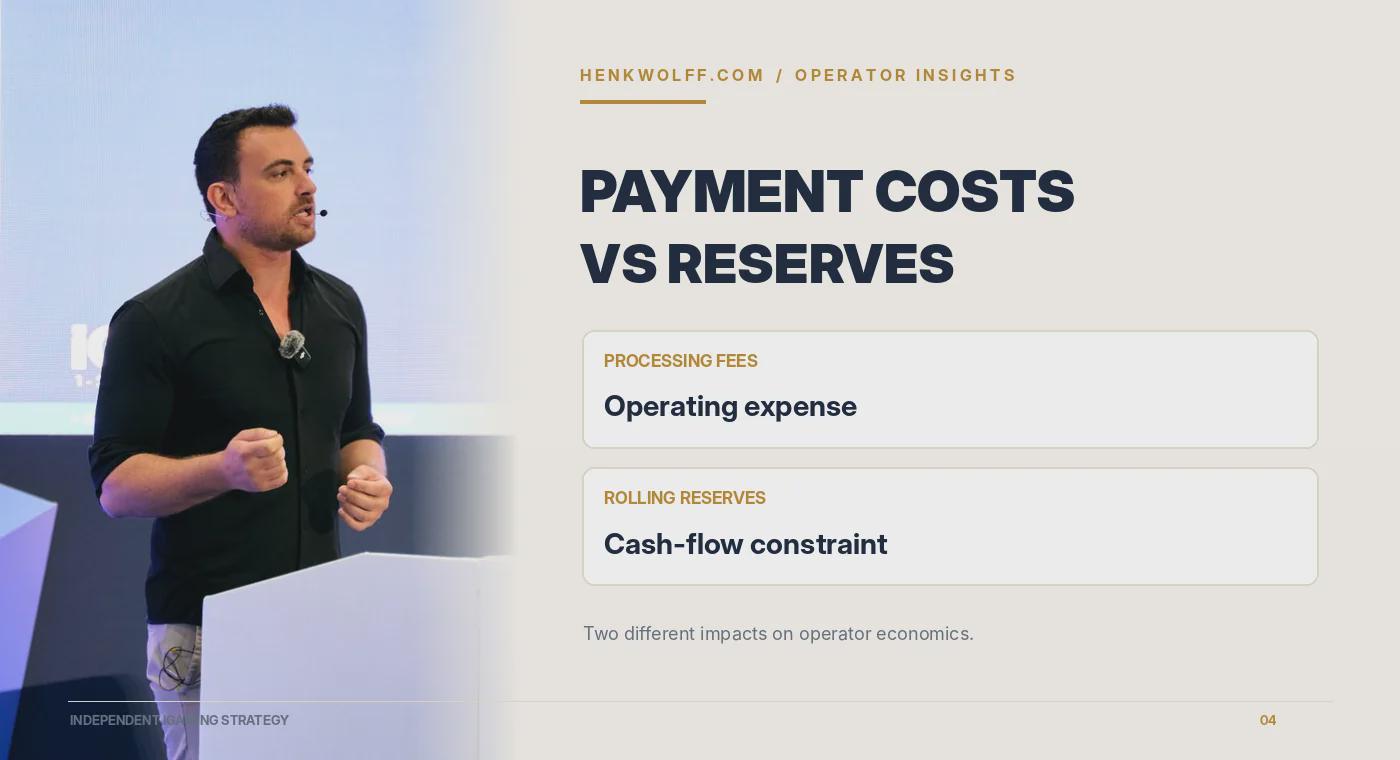
For accounting and available-cash treatment, refer to payment risk management. Do not confuse a retained reserve with a booked transaction expense.
9. Build withdrawal and AML controls before adding another deposit button
Every APM requires a plan for money moving back to the right customer. Returning funds to the same verified source where appropriate is generally more defensible than allowing an unrestricted transfer to another instrument.
The UK Gambling Commission’s April 2025 guidance on open-loop payments strongly recommends closed-loop systems and requires suitable controls where open-loop arrangements remain.
For British-facing remote gambling operators, the current LCCP 5.1.2 payment-services condition also matters. The October 2025 UKGC emerging-risk notice reminds operators of payment processor and method key-event reporting and their own customer due diligence. A PSP’s checks do not simply replace operator KYC.
For each proposed method, document:
- Who owns the source instrument and how this is verified.
- Whether deposits can come from prohibited, excluded or unrelated sources.
- What identity and AML evidence the operator receives and retains lawfully.
- How winnings are returned, including failed payouts and exceptional cases.
- Which funds are refundable, withdrawable or under a legally justified hold.
- Who approves manual exceptions and how they are audited.
- How the method is suspended if a provider loses approval or service fails.
Do not intentionally delay legitimate withdrawals as a retention mechanism or market a route that bypasses customer safeguards.
10. The 30-day implementation plan I would use
Days 1–7: map permissions. Confirm permitted countries, products, licences, merchant approval and funding sources. Create the method-level register and exclude unsuitable payment arrangements.
Days 8–14: model demand and cost. Analyse existing legally eligible player journeys and actual PSP declines. Request contractual offers and test settlement, payout and reserve arithmetic. Identify exactly how each method will improve access or resilience.
Days 15–21: integrate and test. Implement status webhooks and idempotent credits. Exercise declined transfers, device switching, lost sessions, partially settled deposits, duplicate callback delivery and withdrawal failures without risking real customer money.
Days 22–30: conduct a measured release. Roll out only after legal and payment operations sign-off. Monitor genuine conversion, disputes, provider uptime, cash coverage, customer complaints and legitimate withdrawals. Keep a documented rollback procedure.
For commercial negotiations, pair this plan with the casino payment-processing procurement framework rather than accepting a provider’s one-page feature comparison.
What the weekly APM dashboard should show
| Metric | Proper operational denominator | Diagnostic use |
|---|---|---|
| Eligible cashier views | Verified journeys in approved markets | Avoids mixing prohibited and eligible traffic |
| Method-selection rate | Eligible cashier users seeing a method | Tests visibility and genuine demand |
| Initiation-to-confirmed-credit | Authorised attempts ending in correctly credited balances | Captures redirects, timeouts and delayed settlement |
| Approval / rejection reason | Eligible payment attempts by actual provider response | Separates banking risk from technical failure |
| Time to usable balance | Completed deposit to player-wallet credit | Measures real customer experience |
| Payout completion and age | Valid withdrawal requests by method and market | Measures whether funds can leave compliantly |
| Unreconciled items | Count, value and age of mismatches | Identifies ledger and finance exposure |
| Total payment cost | All attributable costs by credited value | Avoids headline processing-fee comparisons |
| PSP and bank concentration | Deposit and payout exposure by underlying dependency | Monitors resilience, not count of logos |
Analyse payment methods within comparable eligible cohorts. A higher approval rate among people choosing a wallet is not proof the wallet causes better retention or lifetime value. Existing users, deposit size, market rules and intent may differ.
Questions to ask before signing an APM contract
A useful operator procurement call should establish the following in writing:
- Which licensed merchant entity, gaming products and consumer jurisdictions will the contract cover?
- Which regulated payment firm holds the client relationship and which acquiring or bank partners actually move the money?
- Can the method be used for both deposits and lawful payouts, and under what return-to-source rules?
- What happens to transactions after a soft decline, bank timeout, fraud review or provider outage?
- What fields, reference IDs, reconciliation exports and webhooks are available?
- What is the full fee schedule, including fixed costs, reversals, FX, reserves and account termination?
- How does the provider prevent prohibited gambling credit-card funding, including within wallets?
- What operator AML / identity controls must remain in place?
- What is the contract’s process for suspended service, withheld funds and player balance recovery?
- Is the proposal conditioned on further due diligence or real merchant approval?
Without these answers, an extra checkout logo can increase operational risk rather than remove it.
FAQs about alternative payments in online casinos
What are the best alternative payment methods for an online casino?
There is no universal best. Open banking, approved e-wallets and eligible local bank rails are candidates to evaluate based on the operator’s actual licences, target markets, player demand and ability to make lawful withdrawals.
Is open banking cheaper than debit cards for iGaming?
It may be, but a provider’s actual fee schedule, fixed charges, completion rate, FX, returns and settlement terms determine the effective cost. Do not substitute third-party benchmark figures for merchant quotes.
Is Apple Pay a separate alternative payment method?
Often it is simply a tokenised card checkout. Check the underlying funding instrument, acquirer and relevant gambling restriction before considering it independent diversification.
Can casinos use prepaid vouchers?
Only where the market, merchant agreement and AML controls permit them. Prepaid products can be high-risk because funding source and recipient traceability may be limited. The UK regulator specifically highlights these risks.
Can online casinos accept crypto payments?
Some lawful business models can, depending on the player jurisdiction, operator licensing, counterparties, custody and AML obligations. A crypto gateway is not a universal permission to take deposits from restricted markets.
Is Pix still an option for online gambling in Brazil in October 2026?
Not as a live gambling deposit recommendation. Brazil’s Finance Ministry states that Provisional Measure 1.394, dated 25 September 2026, prohibited fixed-odds betting and online gaming and stopped new deposits during the transition. Pix remains a general payment rail, but gambling eligibility is a different matter. Verify any later legal changes with the regulator.
Are online casino payments through PayID legal in Australia?
An ordinary bank transfer rail does not make an online casino legal. Australia’s ACMA states that providing online casino services to people in Australia is prohibited. Licensed wagering is a separate product with its own restrictions.
What is the main risk of adding too many payment methods?
Fragmented reconciliation, weak source-of-funds controls, PSP and banking dependencies, payout failures, unaccounted fees and inconsistent customer support. An operator needs control of the full money journey.
A payment mix review before you sign
I work with operators on payment acceptance, cashier UX, PSP selection, risk controls and commercial structures. The first useful output is not a preferred-provider list. It is a market-by-market eligibility and operating model covering genuine player needs, real merchant approvals, deposits, payouts and finance.
If you are preparing a launch or fixing an existing casino cashier, I can help review the operating requirements, identify unnecessary friction and prepare a vendor decision framework. Legal eligibility remains subject to regulator and independent counsel review.
Discuss your payment methods →
Read the related articles on casino payment processing, payment risk management and white-label casino costs.
Research notes, reviewed 24 October 2026: Primary legal and regulatory sources include the Brazilian Finance Ministry’s September 2026 prohibition guidance, ACMA’s Interactive Gambling Act overview, UKGC LCCP 5.1.2, UKGC LCCP 6.1.2, UKGC guidance for wallet funding, UKGC guidance for prepaid methods, UKGC open-loop payment risk, European Commission on instant payments and EBA PSD2 payment status clarification.
About the author: Henk Wolff, independent iGaming consultant. This is an operator-side framework based on available public rules and payment-operations research, not legal advice or an independent certification of the methods and providers mentioned. No named PSP is recommended without merchant-specific due diligence.