
Casino payment processing is the combination of systems, payment partners and controls that turns a player’s attempted deposit into an authorised, recorded and eventually settled transaction. It also supports payouts, reconciles money against player balances and deals with reversals, fraud and payment disputes. For operators, it is simultaneously a conversion function, treasury dependency and regulated risk.
A standard e-commerce checkout rarely faces the same mix of gambling-related acquiring restrictions, payer verification, licensing conditions, withdrawal obligations, fraud patterns and rolling reserves. In casino and sportsbook operations, selecting a provider purely on its quoted percentage rate can therefore be a very expensive mistake.
This is an independent, operator-side procurement and audit framework, not a paid provider ranking. I do not claim to have run equivalent test transactions through every named supplier, and their commercial rates, availability and permitted markets require written confirmation.
The operator’s short answer
A workable payment stack has to answer five questions before launch:
- Can we lawfully take this payment? Check the operating entity, licence, customer market, payment partner and payment method. Approval from a PSP is not a substitute for gambling-market authorisation.
- Will the deposit complete? Measure cashier completion and eligible authorisation accurately by market, issuer, method, device and new-versus-returning player.
- Where does the money go? Document the settlement entity, merchant account, currencies, reserve formula, release timetable and reconciliation path.
- Can we pay the player safely and promptly? Define the payout method, permitted verification process, funding source and exception handling.
- Can the business survive losing a provider? Know the migration plan, data export rights, responsible owner and realistic recovery time.
My recommendation: Select the operating model first, then evaluate payment acceptance, settlement, risk controls and total cost together. A low headline fee means little if a provider cannot support your licensed market or release your cash when needed.
How casino payment processing actually works
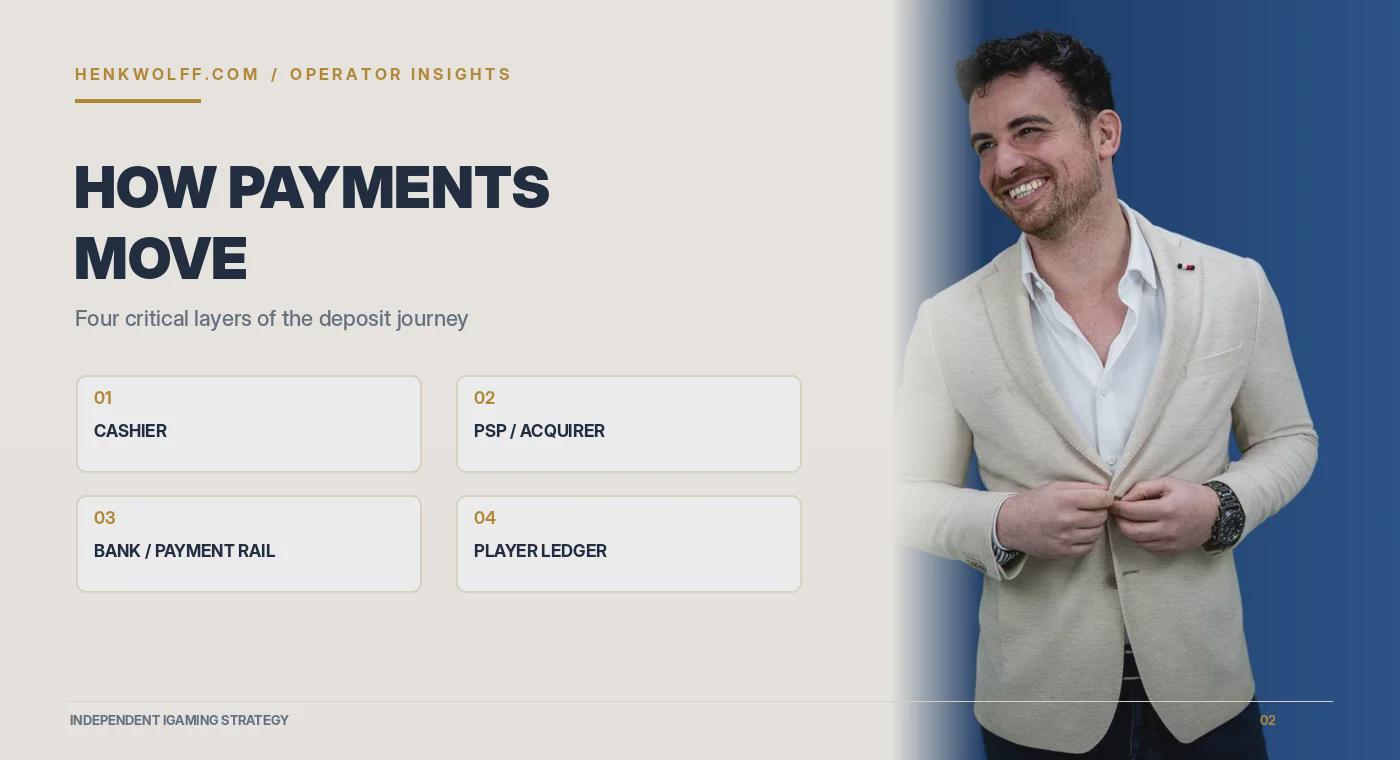
The first mistake is treating the cashier, gateway, acquirer, PSP and payment orchestrator as different names for the same system. They solve different problems, though suppliers can bundle several layers.
| Layer | Actual job | What to verify |
|---|---|---|
| Player-facing cashier | Shows eligible payment methods and collects the payment instruction | Mobile completion, correct country and currency, error handling, accessibility |
| Gateway | Securely passes payment data and requests to processor connections | Tokenisation, uptime, API contract, idempotency, reporting |
| Orchestration layer | Selects among authorised payment routes and collects responses | Transparent routing logic, failure handling, provider independence |
| PSP / acquirer | Delivers or arranges payment processing and merchant acceptance, sometimes including settlement | Legal entity, gaming acceptance, supported markets, reserve and settlement terms |
| Scheme / local rail / issuer | Applies payment-network and bank-level authorisation or transfer rules | Eligible payment instrument, genuine decline reasons, applicable constraints |
| PAM and player ledger | Records playable balances and transaction history | Atomic updates, duplicate prevention, refunds, reconciliation |
| Treasury and finance | Verifies actual settled and withheld funds | Fee files, reserve ledger, FX, daily variance resolution |
A merchant ID (MID) identifies a merchant relationship with an acquirer or processing arrangement; having a gateway integration does not mean the operator owns a portable acquiring relationship. An orchestration layer is useful only if it connects payment routes the operator can actually contract for and legally use.
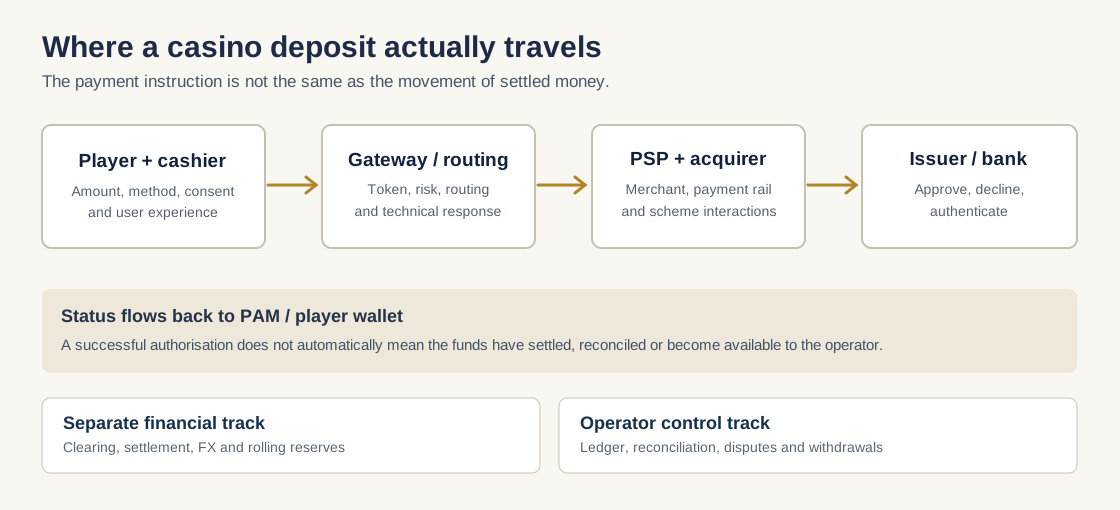
A typical card deposit starts when the player chooses a method. The cashier submits the request through its gateway or orchestration connection. The acquirer, payment network and issuer apply their rules, including any necessary authentication. The operator receives a success or failure result; its PAM should record it exactly once using a stable transaction reference. Funds clear and settle separately according to the relevant arrangements.
Bank transfers, vouchers and e-wallets follow different technical rails. The sequence above is an architectural illustration, not a universal card-scheme diagram for every method.
For withdrawals, start with the player’s verified identity, source-of-funds and relevant risk checks, available balance and authorised destination. The payout must then be instructed, confirmed, posted to the ledger and reconciled. The operator’s internal approval time and the payment provider’s delivery time are separate KPIs.
How to choose the right payment stack

Do not start with a generic list of 30 payment brands. Start with a written operating profile: licence, exact contracting entity, eligible countries, projected volume, currencies, average and peak deposit size, expected withdrawal mix, anti-fraud controls and available engineering resources.
Early-stage operator: A well-supported primary PSP with a reliable cashier may be sufficient at launch. Complexity has a cost: extra integrations, credentials, incident ownership, reconciliations and provider minimums. Plan an alternative route, but do not assume several live acquirers are always economically sensible before demand is proven.
Growing regulated operator: Consider a second genuinely independent processing relationship if concentration risk, measured declines or settlement exposure justify it. Confirm whether the second route uses different acquirers, banks and failure domains. Two logos sharing the same underlying institution might not provide meaningful resilience.
Multi-brand, multi-market operator: More extensive orchestration can be justified when routing and reporting across licensed entities, local methods and acquirers become difficult to manage manually. Treat routing changes as controlled configuration, with audit logs and compliance approval.
I would require three views from every shortlisted vendor: a real user-level payment journey, a merchant settlement and reserve report, and a complete export of transaction events suitable for independent reconciliation.
The provider’s contract is part of the technology
Write down who contracts with whom, who holds funds, who is merchant of record where relevant, who is responsible for scheme disputes, which party can freeze settlement, and which systems still function if one provider terminates. A promise of “full coverage” is not a binding list of permitted countries and regulated gambling products.
Payment methods: the market matters more than the menu
For a market-by-market comparison of pay by bank, e-wallets, local transfer schemes, prepaid options and legally permitted crypto arrangements, see my alternative payment solutions for iGaming operators. It separates general consumer payment rails from gambling merchant approval.
The same payment method can be available for e-commerce yet prohibited, restricted or unsupported for gambling. Assess both the country in which the player is located and the provider’s approved gambling use case.
| Market / method | Operator consideration | 2026 decision rule |
|---|---|---|
| Great Britain: cards and e-wallets | Debit-card and eligible payment-service routes require scheme, PSP and UKGC checks | Credit-card-funded gambling is prohibited, including relevant indirect wallet funding |
| EEA: cards and pay by bank | PSD2/SCA, local methods and national gambling rules interact | Validate both payment regulation and local gaming permission |
| Europe: local bank and wallet methods | Recognition and trust vary by country; integrations and eligibility vary | Test country-specific availability and withdrawal support |
| Brazil: formerly used local rails | The regulatory position changed sharply in September 2026 | Do not treat Brazil as an ordinary active fixed-odds betting/online casino acquiring market |
| Cryptoasset payments | Wallet ownership, source of funds, custody, volatility and on/off-ramp obligations | Offer only where the operator, payment partner and market rules permit it |
| Prepaid methods / vouchers | Additional verification and source-of-funds limitations | Validate product-level gaming permissions and abuse controls |
Brazil regulatory alert, reviewed 24 October 2026: Brazil’s Ministry of Finance states that Provisional Measure 1.394/2026 prohibits the operation, offering, intermediation and advertising of fixed-odds betting, including associated online games. It introduced a wind-down and return-of-funds process. The Central Bank’s Resolution 590/2026 directs payment participants to prevent prohibited transactions while allowing specified closure and refund transactions. Pre-September 2026 articles describing normal deposit acquisition in Brazil must not be relied on as current operating advice. Confirm the live legal status before acting because provisional measures and related legislation can change.
For Great Britain, the UK Gambling Commission’s LCCP condition 6.1.2 prohibits accepting credit cards for gambling, including payments through money service businesses. The Commission’s wallet-funding guidance requires controls preventing circumvention. Its condition 5.1.2 separately sets requirements for payment service providers used by remote licensees. These are distinct obligations.
In the EEA, PSD2’s strong customer authentication framework can affect payment journeys; it does not override each state’s gambling rules. Availability of a method, payout capability and source-of-funds treatment must all be checked for the actual market.
What casino payment processing really costs
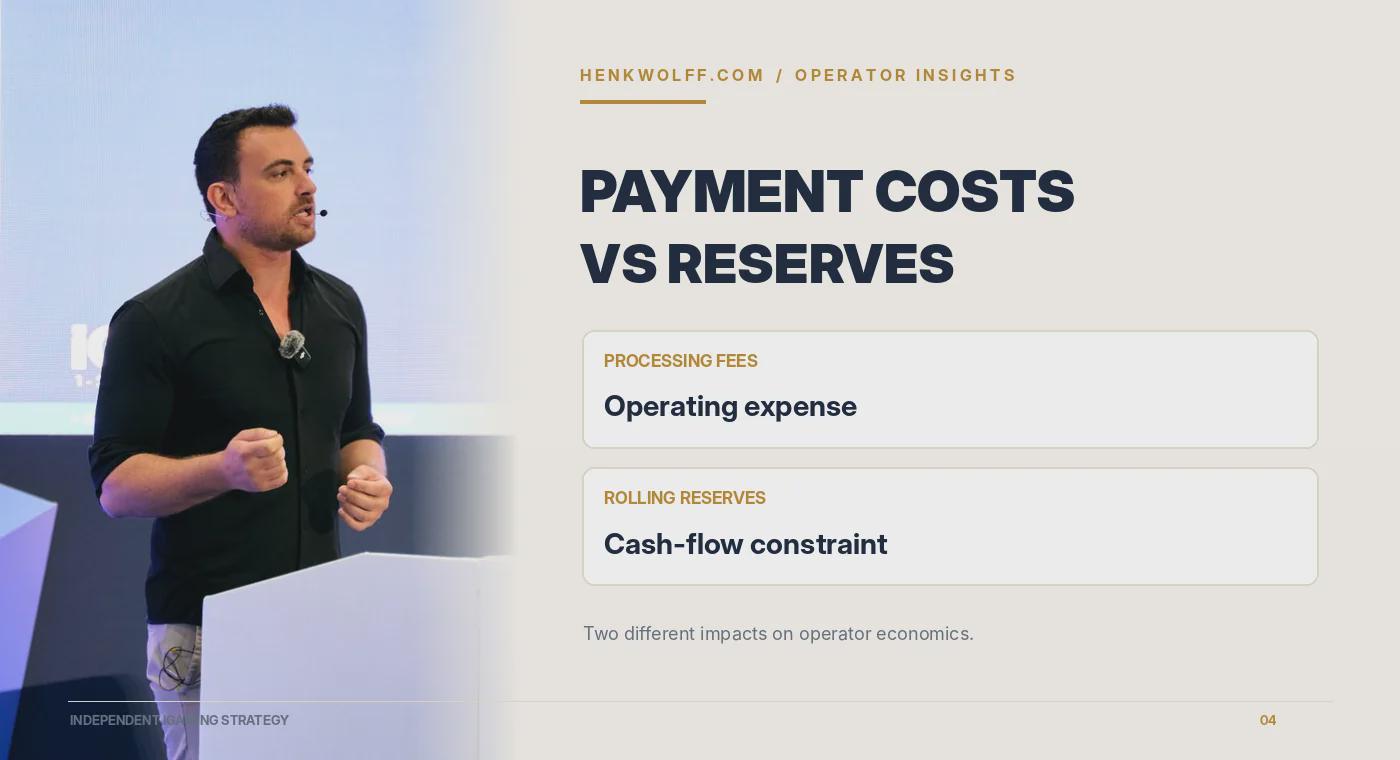
A PSP quotation might advertise one percentage, but the operator’s economics depend on accepted volume, fixed fees, failed attempts, settlement deductions, reserves, chargebacks, FX and operational effort.
| Commercial item | What to request in writing | Common modelling mistake |
|---|---|---|
| Percentage and fixed transaction fee | Rate by country, currency, method and value band | Applying a headline rate to every transaction |
| Authorisation and failed-attempt fee | Events charged on both success and failure | Excluding high decline volume |
| Gateway / orchestration / cashier charge | Per attempt, per success, licence or monthly minimum | Comparing bundled and unbundled stacks unfairly |
| Cross-border and currency conversion | Applied exchange rate, spread and recipient currency | Looking only at explicit FX fees |
| Chargebacks and disputes | Fees, liability, evidence deadlines and monitoring | Treating chargebacks only as processor expenses |
| Rolling or fixed reserve | Base, percentage, release date and termination treatment | Calling retained cash a permanent cost |
| Settlement schedule | Cut-off, holidays, batch processing and deductions | Assuming authorised funds equal available cash |
| Contract and offboarding | Integration, volume commitments, termination and data export | Ignoring switching and locked-in funds |
An illustrative deposit-cost model
These figures are hypothetical, not a benchmark or supplier offer. Assume 1,000 eligible deposit attempts with a €50 average successful deposit, a processing fee of 2.5% plus €0.20 per success, a €0.05 fee per attempt, €0.10 per failed attempt and no chargebacks, FX or other charges in the illustration.
| KPI | 80% approval | 85% approval |
|---|---|---|
| Deposit attempts | 1,000 | 1,000 |
| Approved deposits | 800 | 850 |
| Approved deposit value | €40,000 | €42,500 |
| Percentage fees | €1,000.00 | €1,062.50 |
| Per-approved transaction charges | €160.00 | €170.00 |
| Authorisation charges | €50.00 | €50.00 |
| Failed-attempt charges | €20.00 | €15.00 |
| Total illustrative processing cost | €1,230.00 | €1,297.50 |
| Effective cost / approved value | 3.08% | 3.05% |
The second scenario has €2,500 more completed deposit value, not €2,500 more gaming revenue or profit. Further play, withdrawals, refunds, risk and margin determine the commercial outcome. Do not attribute a hypothetical approval improvement to a particular PSP without a controlled test.
The general calculation is:
Effective processing cost rate = (percentage fees + fixed successful fees + authorisation and failure charges + relevant other costs) ÷ successful deposit value.
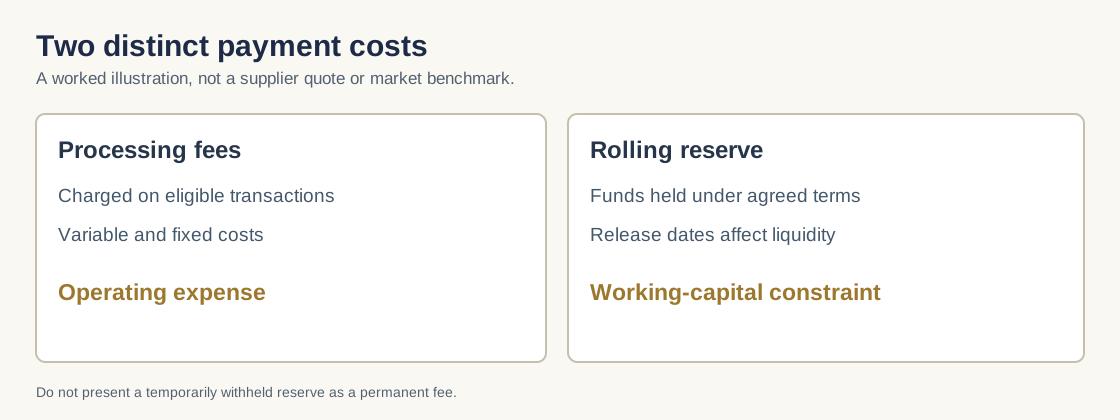
Then separately calculate liquidity tied up: for example, a hypothetical 10% reserve on €40,000 of covered transactions would temporarily withhold €4,000, subject to the contract’s basis and release rules. This is a cash-flow constraint, not automatically an expense or loss. A reserve may become a cost only through defined deductions, unrecoverable funds or financing costs.
Approval rate is not your whole cashier conversion funnel

Measure these denominators separately:
- Cashier-to-attempt conversion: distinct eligible cashier sessions producing a submitted attempt / eligible cashier sessions.
- Authorisation rate: issuer- or scheme-authorised eligible card attempts / eligible submitted card attempts.
- Completed payment success: finally credited, confirmed deposits / valid submitted payment attempts, after technical failures and reversals under the agreed window.
- Registration to first-time deposit: distinct new verified registrants with a first completed deposit / distinct eligible registrations in the cohort.
- Returning player payment success: completed returning-player deposits / eligible returning-player attempts.
- Withdrawal completion: valid payout requests paid within the defined service window / valid payout requests received, with meaningful exclusion codes.
These are recommended working definitions. Providers may calculate differently. Require raw event exports, de-duplication rules and consistent timestamps before comparing approval-rate percentages.
Better acceptance can result from clearer cashier method ordering, accurate issuer data, an appropriate authentication flow, correct local-method availability and repair of genuine outages. It is not appropriate to route around gambling blocks, misclassify merchants, circumvent authentication or repeatedly retry transactions that banks have declined for valid reasons.
Withdrawals: the other half of the payment experience
A player may see “withdrawal approved” inside a casino account while the money is still moving through the provider’s payout process. Operators should display and monitor the distinction between request received, checks completed, payment instructed and destination confirmed, rather than hiding all stages behind a single green tick.
For payout design, check identity and payment ownership, approved methods, AML and safer-gambling interventions, insufficient merchant liquidity, time-to-first-response, time-to-instruction, network settlement and support escalation. A payment processor can support card deposits without supporting payouts to that same card, geography or issuer.
The Nuvei payout documentation illustrates why gaming withdrawals need their own API, eligibility and scheme requirements. The relevant payout capabilities must be confirmed in the contracted product and location.
Reconciliation should be a daily control. Match transaction-level PAM events to processor reports, bank settlements, reserve movements, refunds and dispute records using immutable identifiers. Unmatched funds, delayed webhooks, duplicate approvals and payout reversals should appear in an exception queue with an owner and response deadline.
Ask finance for an opening balance + deposits settled - payouts - charges - reserve movements ± adjustments = closing balance bridge. Document whether each term sits at bank, provider, player-funds account or operator ledger level. A matching total is not evidence every individual transaction is correct.
Fraud, disputes and regulation cannot be delegated away
For the incident register, dispute monitoring, reserve exposure and PSP failure response, use the dedicated iGaming payment risk management framework. The processing guide explains the system; the risk guide explains the controls.
Payment processing risk for online casinos is not only stolen cards. It includes third-party funding, mule accounts, synthetic identities, open-loop withdrawals, deposit reversals, bonus abuse, compromised accounts and missing audit trails. Controls should address conduct and customer protection, not just reduce approval friction.
The UK Gambling Commission’s July 2026 remote-casino assessment rates the sector high risk for money laundering and identifies e-wallets, prepaid instruments, third-party methods and cryptoasset-related flows among risk considerations. Its open-loop payment guidance recommends closed-loop withdrawals as best practice and requires appropriate controls for remaining open-loop risks.
The same regulator notes that changes to payment methods or processors may trigger reporting under LCCP 15.2.1. Do not treat an alternative PSP as a compliance workaround.
Where cardholder data is handled, assess PCI DSS scope and service-provider obligations. PCI SSC published v4.0.1 and began stakeholder consultation on its next iteration in June 2026; verify the version applicable when implementing. Tokenised or hosted card fields can reduce exposure, but they do not eliminate every operator duty.
Likewise, validate 3-D Secure, PSD2 SCA where applicable, merchant category treatment such as MCC 7995 in relevant card contexts, sanctions screening, KYC, AML monitoring, fraud rules and written responsible-gambling exclusions. Schemes have their own changing dispute-monitoring programmes: do not build your controls around an unverified universal chargeback threshold.
Non-negotiable procurement test: Simulate an attempted deposit from an ineligible jurisdiction, a prohibited funding source, a self-excluded player and a blocked account. The system should refuse the transaction where required and preserve a usable decision log. Test lawful payout exceptions separately.
Payment-provider shortlist: compare the right product categories
These suppliers illustrate different layers, not a verified global ranking or confirmed approval for any specific licence. Positioning is based on their published materials or technical documentation.
| Example | Primary proposition | What the operator still must check |
|---|---|---|
| PaymentIQ | Payment orchestration and connections across providers | Exact connector scope, contracted merchants, reporting and migration rights |
| Nuvei | Acquiring, payment methods and payout technology | Gaming acceptance per entity, market, merchant ID and payout route |
| Paysafe / PaysafeCard | Gambling-relevant wallets or prepaid methods and merchant services | Product and jurisdiction restrictions; wallet-funding eligibility |
| Trustly | Pay-by-bank, deposits and certain payout flows | Supported banks, geography and merchant configuration |
| Fluid | Player-facing cashier and conversion layer | Existing PSPs, risk ownership and how integration claims apply to your stack |
| Praxis / other orchestrators | Payment routing and/or cashier integration | Which functionality is native, licensed, bundled or partner-delivered |
| Platform-bundled cashier | Cashier embedded in an existing casino platform | PSP independence, portability, withdrawal handling and reporting |
For context, PaymentIQ became a standalone company in March 2026 following its sale by Worldline. That does not change an operator’s obligation to verify present contractual terms. Trustly describes gaming deposits and withdrawals where enabled; Fluid expressly positions itself as a cashier rather than the processor that holds merchant funds.
I would ask every supplier for the same anonymised merchant profile and written scope, including all pass-through rates. Do not compare a cashier UX SaaS quote against a fully bundled PSP/acquirer offer as if they were identical.
A weighted procurement scorecard
A useful starting point, which the operator should adjust:
| Criterion | Suggested weight | Minimum proof |
|---|---|---|
| Permitted markets, licence fit and operational compliance | 25% | Written product and contracting-entity approval |
| Reconciliation, settlement and reserve transparency | 20% | Actual sample files and reserve schedule |
| Payment-method coverage and eligibility | 15% | Bank/rail/provider evidence by market |
| Resilience and incident handling | 15% | Failure drill with contractual support path |
| Total commercial cost over 12 months | 15% | Itemised contract and representative simulation |
| Integration and exit portability | 10% | API tests, export and transition clauses |
Treat compliance as a hard gate, not a criterion a vendor can compensate for with low price or attractive design. All weights above are advisory, not independently validated provider scores.
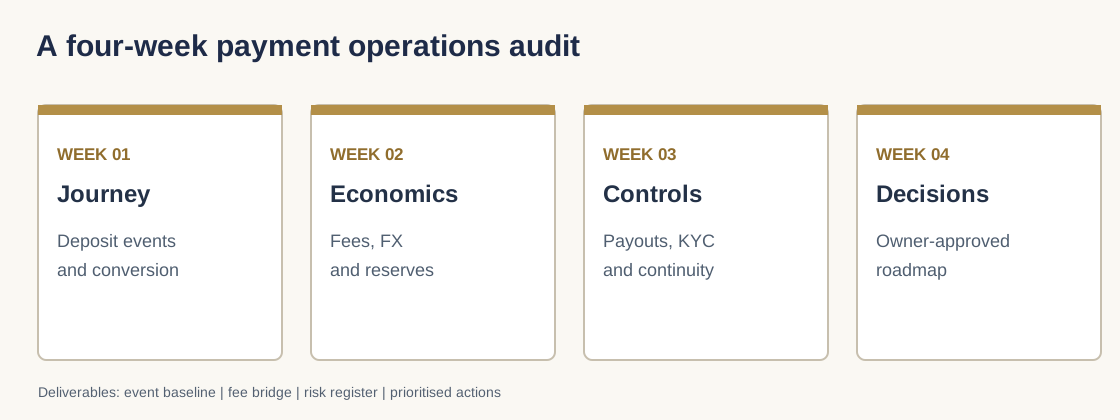
A 30-day payment operations audit

You can learn more in four disciplined weeks than from months of generic feature demonstrations.
Week 1: map the real user and money flows
Export 30–90 days of consent-safe, minimised transaction events, with the relevant finance-team approvals. Trace registration, identity checks, cashier open, selected method, attempted deposit, issuer or bank decision, eventual balance credit and support interactions.
Deliverable: One funnel per market and payment method, with agreed denominator definitions, accurate error categories and a documented source-of-truth event map.
Week 2: reconcile approval, cost and cash
Compare the PAM ledger with PSP export files, bank credit entries, reserve deductions and refunds. Quantify recurring fees, expired approvals, retry costs, payout charges and unreconciled exceptions.
Deliverable: A fee bridge by provider, settlement calendar, reserve ageing schedule and a ranked list of confirmed leakage points.
Week 3: test operational and compliance resilience
Audit self-exclusion and gambling-market eligibility gates, third-party funding controls, payout ownership, chargeback evidence, processor outage handling and manual escalation paths. Test one provider loss scenario in a safe environment.
Deliverable: Control gap register, vendor dependency map and payout incident playbook with accountable owners.
Week 4: prioritise and approve changes
Propose only lawful, measurable interventions: better cashier error copy, improved eligible local-method presentation, clearer balance states, correct event handling or renegotiated terms where financially justified. Define the hypothesis, control group when appropriate, expected cost, owner and stop condition for each change.
Deliverable: A 90-day implementation roadmap, QA cases, approval matrix, KPI dashboard specification and a realistic working-capital plan.
Before signing a PSP agreement: 14 questions
Use this checklist in your commercial and legal review.
- What is the exact legal entity signing the merchant contract, and which licensed brands can use it?
- Which player countries, currencies, payment methods and gaming products are expressly approved?
- Who is the acquirer and which underlying bank relationships are critical dependencies?
- Who owns the MID, payout tokens, transaction references and exportable event data?
- Which percentage, per-attempt, per-success, refund, dispute and monthly minimum fees apply?
- What is the precise reserve calculation, release schedule and post-termination handling?
- What net settlement schedule applies, including holidays and multi-currency conversion?
- What happens to funds, pending payouts and data access if the contract ends immediately?
- How are chargebacks submitted, reconciled and evidenced, and who is financially liable?
- How are fraud, self-exclusion, KYC and prohibited jurisdiction rules enforced?
- What is the support and incident SLA and who can escalate a payout or major outage?
- Can we add or remove a provider without rebuilding the cashier and the player ledger?
- Which subcontractors, payment schemes and third countries process or hold sensitive data?
- What test cases, sandbox support and live acceptance criteria are contractually agreed?
If the vendor cannot answer questions about settlement ownership or reserve release, a product demo is premature.
Frequently asked questions
What is casino payment processing?
It is the regulated technical and financial stack that accepts attempted player deposits, authorises eligible transactions, credits casino balances, settles merchant funds, handles withdrawals and reconciles financial records.
Why is gambling payment processing considered high risk?
Online gambling can combine industry-specific card acceptance restrictions, chargebacks, fraud, AML risks, customer due diligence, jurisdiction rules and variable settlement exposure. Not every payment provider accepts gambling merchants, even if it accepts ordinary online retail.
What do casino payment processors charge?
There is no reliable universal rate. Fees depend on the contracting entity, market, method, volume, risk allocation, reserve arrangements and bundled technology. Request an itemised effective-cost model rather than comparing one advertised percentage.
What is a gambling merchant account?
It is an account or acquiring arrangement under which an approved gambling merchant can process permitted payments. A website’s gambling licence does not itself create or guarantee a merchant relationship.
Can a new licensed casino obtain a PSP?
Potentially, if the payment provider supports the operating entity, gaming product, player jurisdictions and compliance profile. New operators should allow for onboarding, documentation and reserve negotiations; approval is not automatic.
How can an operator improve deposit acceptance legally?
Measure the whole funnel, categorise legitimate failures, repair faulty integrations, present approved payment methods clearly and test appropriate customer authentication. Do not disguise gambling transactions, miscode merchants or bypass issuer restrictions.
What is a rolling reserve?
It is an agreed portion of processed value temporarily withheld by a provider under a defined release arrangement. It affects operator liquidity; it is not necessarily a fee, loss or permanent deduction.
Should an online casino use more than one payment service provider?
It depends on the scale, market diversity, outages, settlement concentration and operational capacity. A tested second independent route can improve resilience, but redundant credentials sharing the same bank do not guarantee failover.
Can online casinos accept cryptocurrency?
Only if the operating jurisdiction, operator licence, provider, AML framework and relevant cryptoasset rules permit the model. Do not treat a foreign gaming licence or wallet integration as universal payment permission.
What happens when a provider stops processing gambling transactions?
Deposits may fail, payouts or reserves may remain pending, and the operator may need approved alternative routing, customer communications and contractual offboarding. Test this scenario and keep reconciliation records before it occurs.
Payment strategy should start with the operator’s economics
A payment processing decision influences first-time deposits, customer service, revenue recognition, cash-flow forecasting, financial risk and the ability to enter a regulated market. That is why I assess it alongside casino startup economics, not as a last-minute checkout integration.
Is your casino losing deposits or carrying unnecessary payment costs? I can review the cashier journey, quantify known friction, challenge PSP and reserve terms, and help prioritise the next operator-side decisions. Any engagement is individually scoped and quoted.
Discuss your casino payment setup →
For teams still planning a launch, read the online casino launch guide, then review whether your payment assumptions match the licence, platform and player markets you are considering.
About the author: Henk Wolff is an independent iGaming growth and operator strategy consultant. The recommendations in this article are practitioner judgement rather than a certified audit of the named payment vendors. No provider paid for placement. Originally drafted June 2026; materially reviewed and expanded 24 October 2026.
Primary references and technical material: UKGC LCCP 6.1.2; UKGC payment methods 5.1.2; UKGC 2026 remote-casino risk assessment; Brazil Ministry of Finance October 2026 position; Brazil BCB Resolution 590; PCI SSC; ECB payment authentication; Nuvei payout guide; PaymentIQ ownership change.